Story and Photos By Lee Schwabe
| The
Blue Lagoon Story and Photos By Lee Schwabe |
|
|
|
| For
more than a century, crowds have been coming to Lagoon Amusement Park near
Salt Lake City- not only to enjoy its proximity to a beautiful lagoon, but
to chase their blues away as well. Located just north of Salt Lake City,
Lagoon amusement park is a delight that the people of Utah have grown up
with. More than a century old, this park has managed to retain the flavor
of a traditional amusement park while keeping up with the times-offering
thrill rides, kiddie attractions, live entertainment, and a myriad of picnic
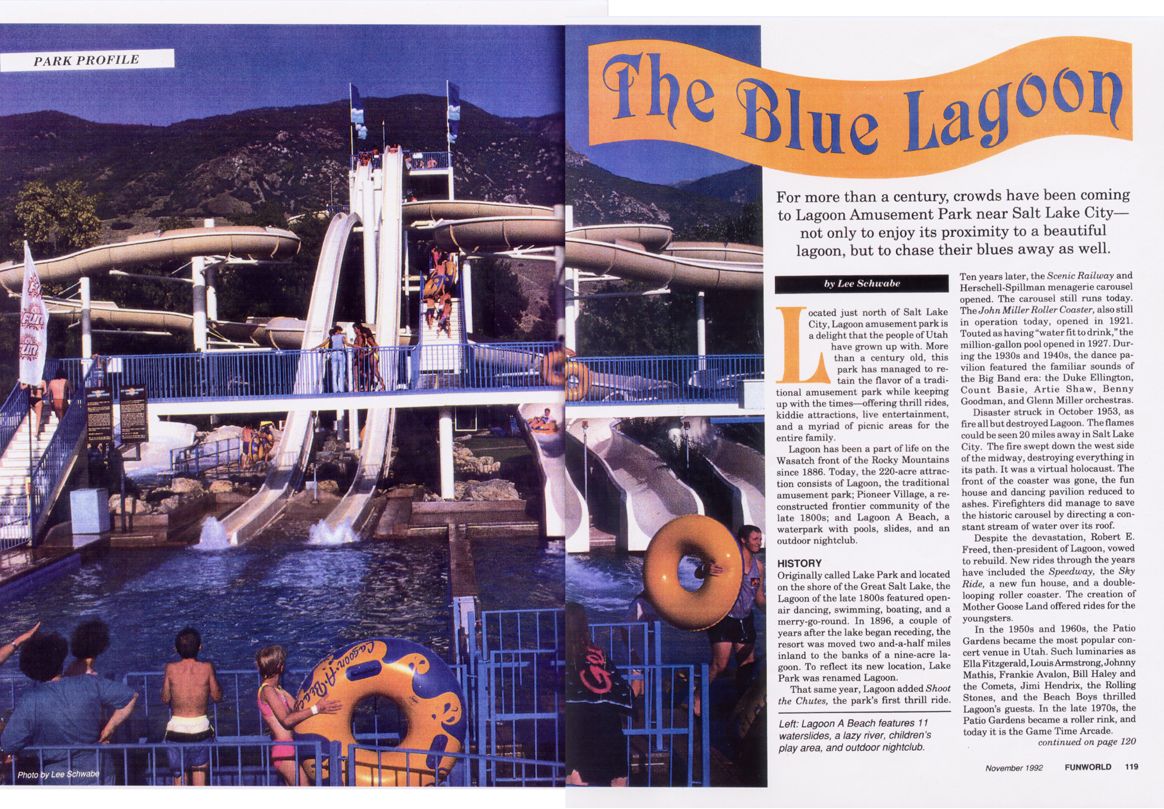
areas for the entire family. Lagoon has been a part of life on the Wasatch front of the Rocky Mountains since 1886. Today, the 220-acre attraction consists of Lagoon, the traditional amusement park; Pioneer Village, a reconstructed frontier community of the late 1800s; and Lagoon A Beach, a water park with pools, slides, and an outdoor nightclub. |
| HISTORY |
| Originally
called Lake Park and located on the shore of the Great Salt Lake, the Lagoon
of the late 1800s featured open-air dancing, swimming, boating, and a merry-go-round.
In 1896, a couple of years after the lake began receding, the resort was
moved two-and-a-half miles inland to the banks of a nine-acre lagoon. To
reflect its new location, Lake Park was renamed Lagoon. That same year, Lagoon added Shoot the Chutes, the park's first thrill ride. Ten years later, the Scenic Railway and Herschell-Spillman menagerie carousel opened. The carousel still runs today. The John Miller Roller Coaster, also still in operation today, opened in 1921. Touted as having "water fit to drink," the million-gallon pool opened in 1927. During the 1930s and 1940s, the dance pavilion featured the familiar sounds of the Big Band era: the Duke Ellington. Count Basie, Artie Shaw, Benny Goodman, and Glenn Miller orchestras. Disaster struck in October 1953, as fire all but destroyed Lagoon. The flames could be seen 20 miles away in Salt Lake City. The fire swept down the west side of the midway, destroying everything in its path. It was a virtual holocaust. The front of the coaster was gone, the fun house and dancing pavilion reduced to ashes. Firefighters did manage to save the historic carousel by directing a constant stream of water over its roof. Despite the devastation, Robert E. Freed, then-president of Lagoon, vowed to rebuild. New rides through the years have included the Speedway, the Sky Ride, a new fun house, and a double-looping roller coaster. The creation of Mother Goose Land offered rides for the youngsters. In the 1950s and 1960s, the Patio Gardens became the most popular concert venue in Utah. Such luminaries as Ella Fitzgerald, Louis Armstrong, Johnny Mathis, Frankie Avalon, Bill Haley and the Comets, Jimi Hendrix, the Rolling Stones, and the Beach Boys thrilled Lagoon's guests. In the late 1970s, the Patio Gardens became a roller rink, and today it is the Game Time Arcade. |
| PARK LAYOUT |
| Lagoon's
entrance is near the midpoint of the park. A short walk away is the north/south
access midway, which remains the backbone of the park. "If you were designing
an amusement park today," says Dick Andrew, director of marketing, "you
wouldn't design it like this." The melding of old with new has created today's
successful park. The park's 26 major rides stretch north to south, three of which are easily visible from Interstate 15. The 144-foot tall Skyscraper is at the north point, the roller coaster is near the center, and the 85-foot-high Schwarzkopf Fire Dragon anchors the south end. Adjacent to the southwest boundary is Lagoon's recreational vehicle park and campground, which has 250 camping spaces, full amenity hookups, and discounted admission to the park. Also stretching along the midway are the park's 31 games. Brad Egan, considered to be one of the best games managers in the industry, makes sure the games are clean and attractive, and the employees are amiably aggressive, but not annoying. This training is evident as employees often make forays onto the midway to encourage passers-by to play. If declined they wish the patrons a good day. |
| PIONEER VILLAGE |
| A
visit to Pioneer Village is truly a learning experience. Added in 1976,
Pioneer Village is a 15-acre reconstruction of a frontier community of the
late 18OO's. It consists of 42 authentic buildings furnished with artifacts
of the period. At the head of the area sits the Rock Chapel. This building
was constructed in Coalville, Utah, in 1853. Having seen duty as a courthouse,
schoolhouse, and church, it was dismantled and transported stone by stone
to its present location. Other buildings include a two-story log house, smokehouse, cobbler shop, print shop, music hall, and railroad station. The armory features one of the finest collections of small firearms in the country, and Carriage Hall displays almost every kind of wheeled conveyance used at the turn of the century. The Wild West Shoot Out provides entertainment and excitement and, of course, the good guys always win. |
| LAGOON A BEACH |
|
With
the advent of waterparks, Lagoon's large swimming pool simply couldn't
compete with tube slides, wave pools, and other modern attractions. In
1989, Lagoon A Beach opened. Originally, Lagoon A Beach was separate from
the amusement park. However, because it was not generating the expected
attendance, it was combined with the park. Now, 60 percent of Lagoon's
patrons visit the waterpark. |
| ENTERTAINMENT AT LAGOON |
|
Live
entertainment always has been a big part of the Lagoon experience. In
1982, Music USA, a song-and-dance salute to the different genres of American
music, began entertaining visitors. Lagoon also has its own marching show
band, the All-Star Band, made up of top young instrumentalists. Summer
Rhythm is a popular stage show of harmonious pop music, and L.A. Goon
band wanders the midway daily, mixing humor with music. |
| LAGOON'S MARKET |
|
Lagoon
has a relatively small and very isolated market. Of the 1.6 million people
in Utah, 1.3 million are located on a 85-mile north/south stretch at the
base of the Wasatch front. It is hundreds of miles to the next significant
population center Attendance in 1992 was expected to b0 around 950,000.
|