|
|
 |
|
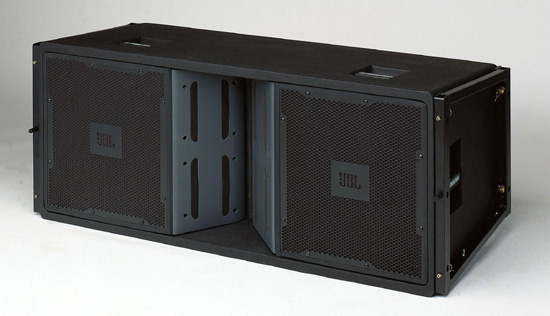
First product in JBL's new VERTEC series: the VT4889 3-way Line Array System. |
|
VerTec™ System Information |
|
FAQ (Frequently Asked Questions) |
|
Q. What does the word VERTEC
mean? A. Vertical Technology. This is an integrated
package of line array research, new acoustical elements, a new loudspeaker
system that includes them, and a predictive software tool for optimizing
the setup of vertical line arrays. Q. “A Line Array With Lineage...”. What’s up
with that? A. JBL is proud of its heritage in line array
research, and its historical products of this type. The lineage, or
“technical pedigree” of any company, and its product lines, will affect
its ability to draw upon broader, deeper resources in technology when the
time comes for developing new product programs. Q. What products are in the VERTEC Series? A. The VT4889 3-way line enclosure and
accessories, along with dedicated array hanging frames for suspending or
stacking these enclosures, are the first products in this new line.
Additions to the product line will be released in the future. Q. What are typical applications for JBL’s
VERTEC Series? A. The VERTEC
Series is ideal for covering medium to large audience areas at concerts,
corporate and civic presentations, worship events, live theatre, film
premieres, televised functions and awards shows, sports events, themed
attractions, and anywhere that consistent audience-area coverage is
important. The system is especially suitable for presenting the live
music, the spoken word, and full-bandwidth playback material in
acoustically-difficult venues. It can work equally well in smaller indoor
facilities or over large distances in outdoor situations. Q. Can the VERTEC system handle
high-level rock music in concert settings? A. Yes. The system’s components have an output capability that exceed those transducers found in other line array systems of this type. Q. Why are line array systems popular? A. When properly designed and assembled, line
array systems provide the system designer or operator with a highly
consistent, predictable coverage field A properly designed line array
system will have reduced component interaction, or comb filtering. in the
horizontal plane. This results from assembling all components in a single,
ribbon-like vertical “line” that does not have conflicts with similar,
adjacent sound radiators pointed in other directions. Q. Are line arrays a new trend? A. No. The fundamental acoustic research that
led to early line array products took place decades ago. In fact, JBL
offered line array systems such as the Model 4682 in the 1970’s. A brief
history of line arrays is described in the White Paper, “JBL’s Vertical
Technology”. Q. What is the basic underlying technology in the
VERTEC system? A. The line array summation effect. This is a
function of basic physics, and is not the result of any advanced or
proprietary engineering. It governs all line arrays, regardless of
manufacturer. JBL’s research in this area, new acoustical elements that
resulted from this research, the new VERTEC system that
includes them, and a proprietary software tool to predict the coverage
patterns of VERTEC systems, make
up JBL’s Vertical TechnologyÔ
platform. Q. Is the line array summation effect valid
for more than just the high frequencies? A. Yes. In any line array system, pattern control
varies with frequency and with the height and size of a line array. Q. What is the difference between the early
“speaker column” line array systems and large-scale modern line arrays
like JBL’s VERTEC system? A.
Early line array systems were typically low-powered systems with
all of the components in a single enclosure. They typically relied on
small (6”, 8” or 12”) cones. Today’s modern line arrays are made up of
modular elements that can be used to create very large, powerful sound
reinforcement systems. Q. Isn’t this just a copy of other line
arrays? A. No. VERTEC is a unique
system. It is the first line array system to offer so much output
capability in such a small enclosure, to employ high-output dual-coil
loudspeaker components in an axially-symmetrical format, and to provide
system users with a flexible, lightweight system that can serve such a
wide range of applications. JBL’s WaveFormerÔ
and R.B.I. (Radiation Boundary Integrator – Patent Pending) are unique
acoustical elements with specific acoustical advantages not found in any
other system. Q. What’s so new about JBL’s VERTEC system? A. JBL has developed new, high-powered
transducers (each with dual voice coils and neodymium magnets for lighter
weight and higher output power) and new compression drivers with beryllium
diaphragms (for excellent sound fidelity) for the VERTEC
system. Patents are in place, or pending, on these components and
the elements that shape their acoustical output. Together these
technologies give the VT4889 the highest power-to-weight ratio of any
product in its class. Q. Are there differences in the array
performance of VERTEC compared to
other competitive systems? A. Yes. Due to the VT4889’s trapezoidal shape,
the front baffle of a VERTEC array will
always have a smooth, continuous surface, regardless of box angle
settings. This has distinct acoustical advantages and ensures that the
line array summation effect in not diminished as boxes are angled
downwards. And, no ratchet-type straps are required for putting tension on
the rear of the array as with other systems. Thus, “No Gaps, No
Straps”. Q. What’s inside the VERTEC system? A. Each VT4889 enclosure includes (2)
lightweight 2255 15” Low Frequency Dual-Coil Differential Drive
loudspeakers, (4) powerful 2250H 8” Midrange Frequency Dual-Coil
Differential Drive loudspeakers coupled to R.B.I.’s (Radiation Boundary
Integrators), and (3) compact 2435 High Frequency drivers fitted to
WaveFormers. Q. What’s an R.B.I.? A. A Radiation Boundary Integrator. These
midrange frequency acoustical elements couple the high output power
capacity of each 2250 8” Midrange speaker to the adjacent low frequency
and high frequency radiating
elements in an integrated manner. The R.B.I. serves multiple purposes. It
creates slot-loaded compression chambers for the midrange cones while
simultaneously smoothing the horizontal response of the high frequency
elements. The net result is reduced intermodulation distortion and a more
integrated wavefront that is a summation of the output of low, midrange
and high frequency elements. Q. What’s a WaveFormer? A. A high-frequency radiating device with very
precise, specific output characteristics enabling it to co-exist and
function directly adjacent to others like it in a narrow, vertical
‘ribbon’ pattern. Like an acoustical transformer, the (3) High Frequency
WaveFormers in each VT4889 system are slot apertures that ensure proper
line array summation characteristics at high frequencies. Q. What does a VT4889 system weigh? A. Each
VERTEC VT4889 enclosure weighs only 69 kg (152
lbs.). This includes all required rigging hardware to connect one box to
another. Q. What
is the size and shape of the VT4889 enclosure? A. Each box is 1213mm x 489mm
x 546mm (19.25 inches tall, 21” deep,
and only 47.75 inches wide. It is a trapezoidal shape with 5-degree angled
sides. Q. How does this system pack in a truck? A. The
sizing enables two enclosures to be stacked vertically on end in the
smaller box rental trucks frequently used by sound hire companies. Up to
100 of the boxes, with a total weight of 6,895 kg (15,200 lbs.), could be
stacked in a (24’) long truck box with a 2,438mm (96”) interior ceiling
height (Typical “Ryder” truck). Cabinets can be loaded five wide, two high
in standard touring trailer truck bodies. Q. How is
the VT4889 transported? A. Each
box has a dolly that doubles as a protective grille cover. There are eight
(8) handles on each enclosure. The soft cover is waterproof and has velcro
straps across the bottom to hold it in place. Hard panels in each end of
the cover bag protect the rigging hardware in transit. Q.
Besides the VT4889-AF Array Frame, what rigging hardware is
required to suspend the boxes in an array? A. None. All required rigging fittings are
integral to the VT4889 enclosure. They comprise sliding hinge bars that
retract into tubular, end-mounted metal frames for storage and transit.
Once the hinge bars are installed in the rigging frames, there are no
extra ‘straps’ or loose fittings to buy, collect and keep track of. Q. What is the hanging hardware included on
each VT4889 box actually like? A. High-grade alloy frames on the two ends of
each enclosure house sliding hinge bars. These can be pinned at positions
ranging from 0 to 10 degrees for each adjacent box. They can be set in
1-Degree increments. Q. How many VT4889’s can be suspended in a single
array? A. Up to eighteen (18) enclosures can be
suspended from one VT4889-AF Array Frame with a 7:1 Design Factor. Q. Can a VERTEC system be
ground-stacked or must it always be flown? A. Yes the system can be ground-stacked. Up to
six (6) enclosures can be stacked on the VT4889-AF Array Frame, which can
be inverted to support a ground stack. Up to three (3) units can be
stacked on the shorter VT4889-SF frame. Q. Some other systems line array systems use a
lower Design Factor, like 5:1. What is the difference? A. A 5:1 Design Factor means that the suspension
hardware will not fail until a stress load of five times the certified
weight is encountered. A 7:1 Design Factor means that the suspension
hardware will not fail until a stress load that is seven times the
certified weight is applied. Different nations of the world have varying
regulations concerning the suspension of contained with each enclosure,
and JBL recommends that a 7:1 Design Factor be adhered to so that the most
stringent regulations are accommodated. Q. Is the system available for sale? A. JBL Professional is accepting advance purchase
orders to gauge production demand. The first mass-production build is
scheduled for November 2000. Interested customers not already in the build
schedule should contact their JBL Regional Representative of International
Distributor for obtaining system price and delivery quotes. |
