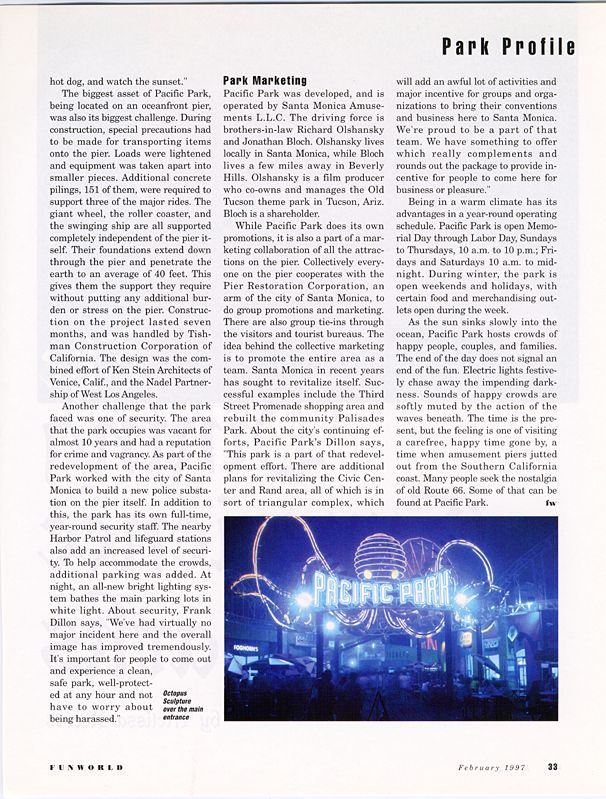
| The Pacific Park is a non-gated, pay-as-you-go facility. Its layout is long and narrow, as one might expect on a pier. Most of the attractions are arranged on both sides of the main east-west midway. Intersecting this is the north-south corridor that contains the food court and main entrance. Straddling the buildings in this area is a roller coaster-like sculpture, topped by a whimsical octopus with 50-foot legs. |
| A Walk Through the Park |
| Entering
the park from the east, guests hear the happy noises of children and kids
rides. This children's area has six rides, four of which are exclusively
for kids and two others on which parents can ride along. PC.H. Driving School
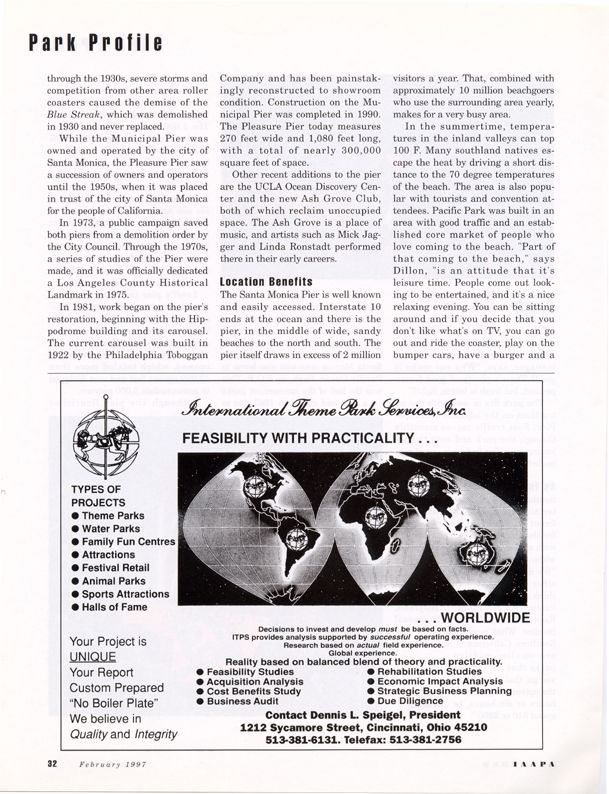
is a miniature bumper car ride that marks the boundary of the kid's zone.
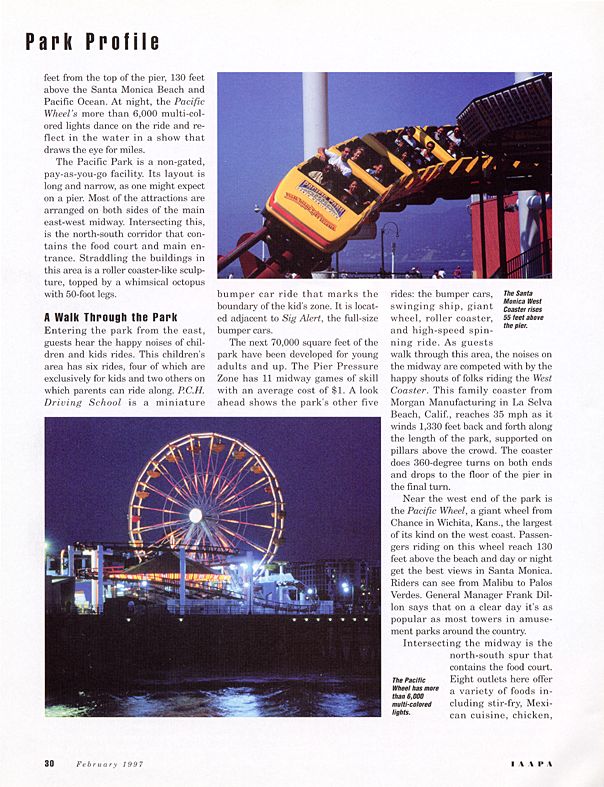
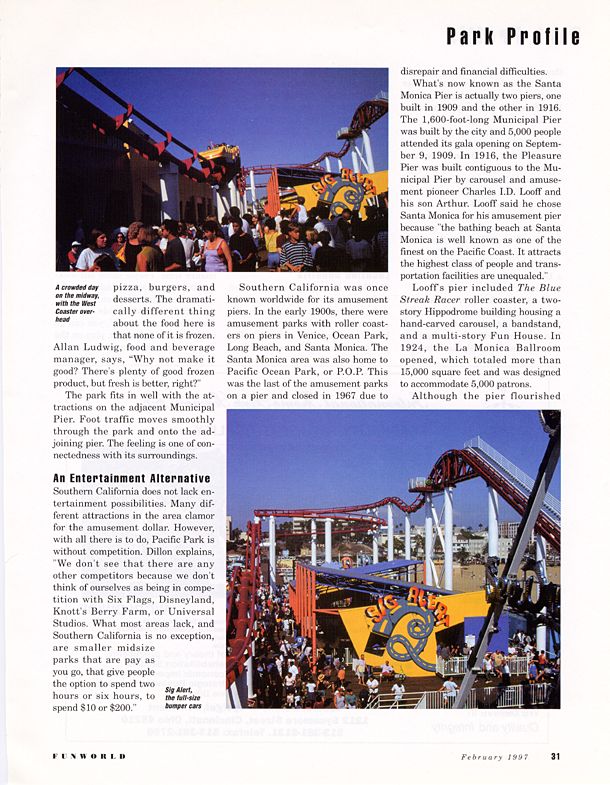
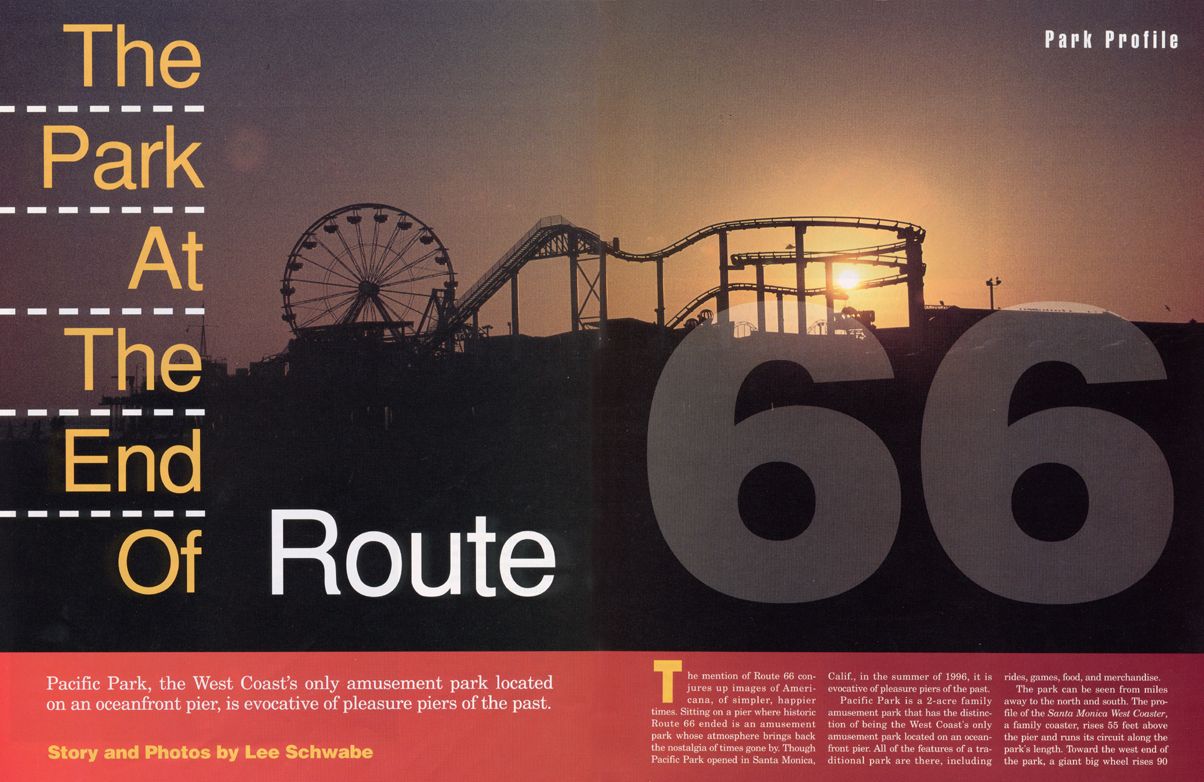
It is located adjacent to Sig Alert, the full-size bumper cars. The next 70,000 square feet of the park have been developed for young adults and up. The Pier Pressure Zone has 11 midway games of skill with an average cost of $1. A look ahead shows the park's other five rides: the bumper cars, swinging ship, giant wheel, roller coaster, and high-speed spinning ride. As guests walk through this area, the noises on the midway are competed with by the happy shouts of folks riding the West Coaster. This family coaster from Morgan Manufacturing in La Selva Beach, Calif., reaches 35 mph as it winds 1,330 feet back and forth along the length of the park, supported on pillars above the crowd. The coaster does 360-degree turns on both ends and drops to the floor of the pier in the final turn. Near the west end of the park is the Pacific Wheel, a giant wheel from Chance in Wichita, Kans., the largest of its kind on the west coast. Passengers riding on this wheel reach 130 feet above the beach and day or night get the best views in Santa Monica. Riders can see from Malibu to Palos Verdes. General Manager Frank Dillon says that on a clear day it's as popular as most towers in amusement parks around the country. Intersecting the midway is the north-south spur that contains the food court. Eight outlets here offer a variety of foods including stir-fry, Mexican cuisine, chicken, pizza, burgers, and desserts. The dramatically different thing about the food here is that none of it is frozen. Allan Ludwig, food and beverage manager, says, 'Why not make it good? There's plenty of good frozen product, hut fresh is better, right?" The park fits in well with the attractions on the adjacent Municipal Pier. Foot traffic moves smoothly through the park and onto the adjoining pier. The feeling is one of connectedness with its surroundings. |
| An Entertainment Alternative |
| Southern
California does not lack entertainment possibilities. Many different attractions
in the area clamor for the amusement dollar. However with all there is to
do, Pacific Park is without competition. Dillon explains, "We don't see
that there are any other competitors because we don't think of ourselves
as being in competition with Six Flags, Disneyland, Knott's Berry Farm,
or Universal Studios. What most areas lack, and Southern California is no
exception, are smaller midsize parks that are pay as you go, that give people
the option to spend two hours or six hours, to spend $10 or $200." Southern California was once known worldwide for its amusement piers. In the early 1900s, there were amusement parks with roller coasters on piers in Venice, Ocean Park, Long Beach, and Santa Monica. The Santa Monica area was also home to Pacific Ocean Park, or P.O.P. This was the last of the amusement parks on a pier and closed in 1967 due to disrepair and financial difficulties. What's now known as the Santa Monica Pier is actually two piers, one built in 1909 and the other in 1916. The 1,600-foot-long Municipal Pier was built by the city and 5,000 people attended its gala opening on September 9, 1909. In 1916, the Pleasure Pier was built contiguous to the Municipal Pier by carousel and amusement pioneer Charles ID. Looff and his son Arthur. Looff said he chose Santa Monica for his amusement pier because "the bathing beach at Santa Monica is well known as one of the finest on the Pacific Coast. It attracts the highest class of people and transportation facilities are unequaled." Looff's pier included The Blue Streak Racer roller coaster, a two-story Hippodrome building housing a hand-carved carousel, a bandstand, and a multi-story Fun House. In 1924, the La Monica Ballroom opened, which totaled more than 15,000 square feet and was designed to accommodate 5,000 patrons. Although the pier flourished through the 1930s, severe storms and competition from other area roller coasters caused the demise of the Blue Streak, which was demolished in 1930 and never replaced. While the Municipal Pier was owned and operated by the city of Santa Monica, the Pleasure Pier saw a succession of owners and operators until the 1950s, when it was placed in trust of the city of Santa Monica for the people of California. In 1973, a public campaign saved both piers from a demolition order by the City Council. Through the 1970s, a series of studies of the Pier were made, and it was officially dedicated a Los Angeles County Historical Landmark in 1975. In 1981, work began on the piers restoration, beginning with the Hippodrome building and its carousel. The current carousel was built in 1922 by the Philadelphia Toboggan Company and has been painstakingly reconstructed to showroom condition. Construction on the Municipal Pier was completed in 1990. The Pleasure Pier today measures 270 feet wide and 1,080 feet long, with a total of nearly 300,000 square feet of space. Other recent additions to the pier are the UCLA Ocean Discovery Center and the new Ash Grove Club, both of which reclaim unoccupied space. The Ash Grove is a place of music, and artists such as Mick Jagger and Linda Ronstadt performed there in their early careers. |
| Location Benefits |
| The
Santa Monica Pier is well known and easily accessed. Interstate 10 ends
at the ocean and there is the pier, in the middle of wide, sandy beaches
to the north and south. The pier itself draws in excess of 2 million visitors
a year. That, combined with approximately 10 million beachgoers who use
the surrounding area yearly, makes for a very busy area. In the summertime, temperatures in the inland valleys can top 100 F. Many southland natives escape the heat by driving a short distance to the 70 degree temperatures of the beach. The area is also popular with tourists and convention attendees. Pacific Park was built in an area with good traffic and an established core market of people who love coming to the beach. 'Part of that coming to the beach," says Dillon, "is an attitude that it's leisure time. People come out looking to be entertained, and it's a nice relaxing evening. You can he sitting around and if you decide that you don't like what's on TV, you can go out and ride the coaster, play on the bumper cars, have a burger and a hot dog, and watch the sunset.' The biggest asset of Pacific Park, being located on an oceanfront pier, was also its biggest challenge. During construction, special precautions had to be made for transporting items onto the pier. Loads were lightened and equipment was taken apart into smaller pieces. Additional concrete pilings, 151 of them, were required to support three of the major rides. The giant wheel, the roller coaster, and the swinging ship are all supported completely independent of the pier itself. Their foundations extend down through the pier and penetrate the earth to an average of 40 feet. This gives them the support they require without putting any additional burden or stress on the pier. Construction on the project lasted seven months, and was handled by Tishman Construction Corporation of California. The design was the combined effort of Ken Stein Architects of Venice, Calif., and the Nadel Partnership of West Los Angeles. Another challenge that the park faced was one of security. The area that the park occupies was vacant for almost 10 years and had a reputation for crime and vagrancy. As part of the redevelopment of the area, Pacific Park worked with the city of Santa Monica to build a new police substation on the pier itself. In addition to this, the park has its own full-time, year-round security staff. The nearby Harbor Patrol and lifeguard stations also add an increased level of security. To help accommodate the crowds, additional parking was added. At night, an all-new bright lighting system bathes the main parking lots in white light. About security, Frank Dillon says, "We've had virtually no major incident here and the overall image has improved tremendously. It's important for people to come out and experience a clean, sate park, well-protected at any hour and not have to worry about being harassed." |
| Park Marketing |
|
Pacific
Park was developed, and is operated by Santa Monica Amusements L.L.C.
The driving force is brothers-in-law Richard Olshansky and Jonathan Bloch.
Olshansky lives locally in Santa Monica, while Bloch lives a few miles
away in Beverly Hills. Olshansky is a film producer who co-owns and manages
the Old Tucson theme park in Tucson, Ariz. Bloch is a shareholder. |